
Your 40s can be a great time for laser eye surgery. Your prescription has likely settled, and you may have spent decades wishing you could ditch your glasses or contacts. There's just one catch. Around the same time, many people start holding their phone at arm's length to read a text.
That shift has nothing to do with your distance prescription, and laser eye surgery won't stop it. Whether you'll end up in reading glasses depends largely on the plan you choose. With the right approach, you can enjoy clear vision across the room and still manage up close. Below, I'll explain what I want you to know before your consultation.
The Science
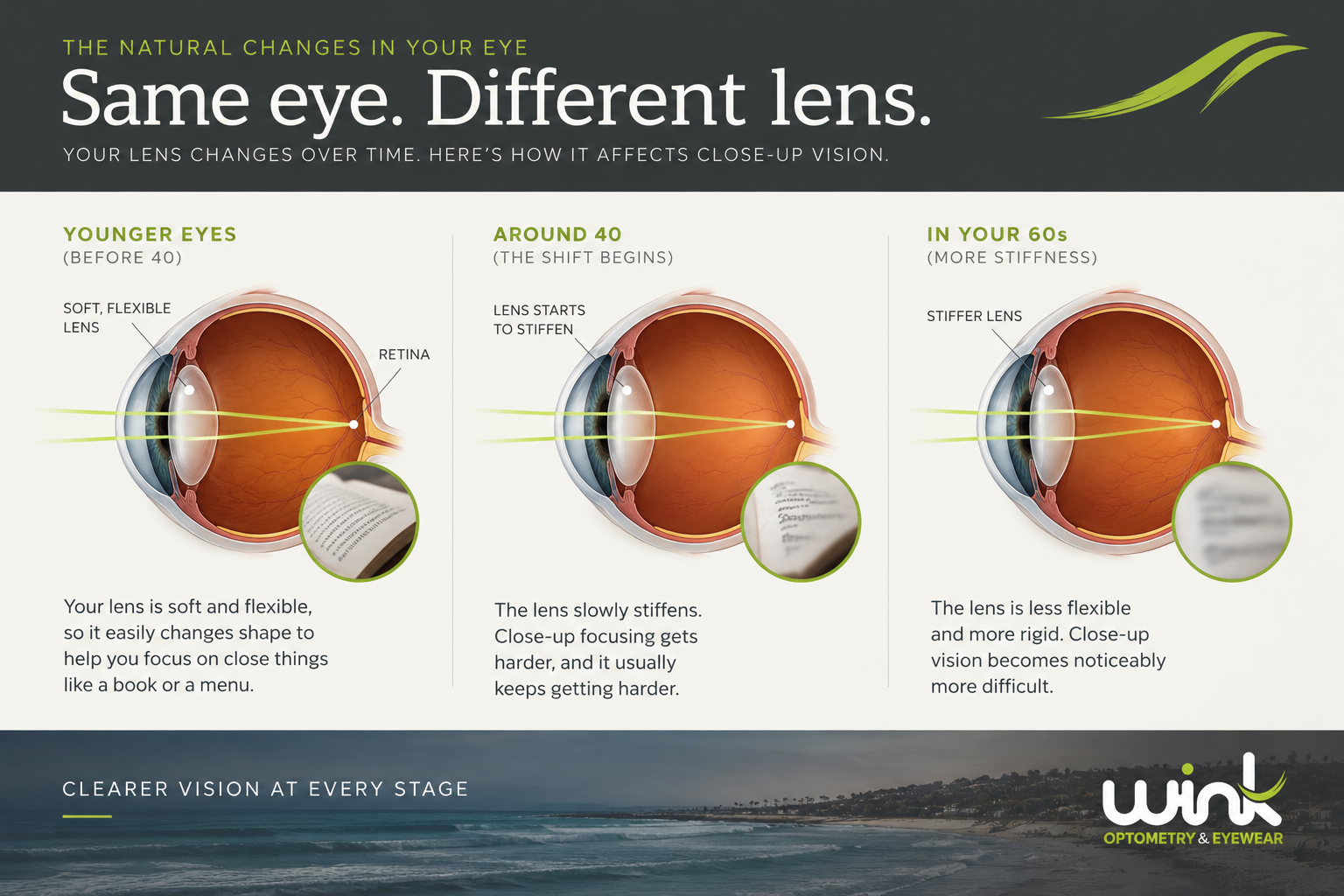
Behind your iris sits your eye's natural lens. When you're young, that lens is soft and flexible. It changes shape to help you focus on things up close, like a book or a menu. Starting around age 40, the lens slowly stiffens. Close-up focusing gets harder, and it usually keeps getting harder into your 60s.
The signs I hear about most often include:
Setting Expectations
LASIK and PRK reshape the cornea, the clear front surface of your eye. That corrects nearsightedness, farsightedness, and astigmatism. Presbyopia, however, comes from the lens inside your eye, not the cornea. Standard laser eye surgery doesn't change the lens.
So if both of your eyes are corrected for distance, you can expect crisp vision for driving, hiking, or watching the sunset over the Pacific. But you'll likely still reach for reading glasses as presbyopia progresses.
A Note for Nearsighted Patients
Many nearsighted people over 40 can read up close just by taking their glasses off. Once your distance vision is corrected, you lose that built-in reading ability. I always make sure my patients understand this trade-off before they decide.
None of this means laser eye surgery isn't worth it after 40. Many of my patients are happy to trade thick glasses or daily contacts for an occasional pair of readers. The key is making the decision with clear expectations.
Your Choices
You have more choices than "perfect distance vision plus readers." These are the approaches I discuss with patients most often.
If you'd rather avoid surgery for now, prescription eye drops that temporarily improve close-up focus are another option worth asking me about.
Beyond Presbyopia
Presbyopia isn't the only age-related change I look at before recommending surgery.
Dry eye becomes more common with age, especially for women around menopause. Laser eye surgery can also make dry eye worse for a while during healing, and breezy coastal days and dry Santa Ana winds don't help. Finding and treating dry eye before surgery can make your recovery much more comfortable.
A thorough exam also checks for early signs of cataracts, glaucoma, and macular degeneration. If I see an early cataract forming, a lens-based procedure may make more sense for you than LASIK or PRK.
Conditions like diabetes or autoimmune disorders, along with some medications, can affect how your eyes heal. Please share your full medical history with me so we can plan safely.
Looking Ahead
No. The distance correction from laser eye surgery is long-lasting. Needing readers later doesn't mean your LASIK failed. Presbyopia is a separate change that would have happened either way.
Later in life, most people also develop cataracts, usually in their 60s or 70s. Past laser eye surgery doesn't prevent cataract surgery. However, it helps to keep a record of your eye measurements from before your procedure, since they can help a future surgeon choose the right replacement lens. That's one more reason I like to stay involved in my patients' care for the long haul.
Be Prepared
Bring These to Your Appointment
Your Next Step
My brother, Dr. Wildon C. Wong, and I help patients over 40 sort through these choices with honest, easy-to-understand guidance. During your consultation, we'll evaluate your eyes, explain which options suit your vision goals, and refer you to one of the area's best surgeons if laser eye surgery is right for you. We also provide your follow-up care close to home.
And if readers end up being part of your plan, our on-site optical lab can make stylish, customized eyeglasses without the long wait.
Our Del Mar and La Jolla offices serve patients throughout Carmel Valley and San Diego County.
Or call (858) 755-9465
At Wink Optometry & Eyewear, we offer a wide range of services. Our optometrists, Drs. Gordon G. Wong and Wildon C. Wong, have over 45 years of combined experience. They also belong to several respected organizations, including:
For more information about our services, contact our office online or call us at (858) 755-9465 today.
Locations
We have 3 locations to visit us at.

